My Mindfulness Rituals for Inner Balance in Everyday Life

Reading time: 9 minutes
Between a business lunch at the Käfer-Schänke in Munich and an evening engagement at the Berlin State Opera, I had a moment last month when I realized: if I don't pause right now, I'm going to lose myself completely. My pulse was racing, my thoughts were jumping between three different projects, and I hadn't had five minutes to myself since morning. Right then and there, I decided to stop treating my daily mindfulness rituals as optional wellness extras and start treating them as an absolute necessity. Eight months later, I can say that these simple daily practices have improved my mental health more than anything else I've tried.
Life in lifestyle dating often moves at a pace that leaves little room for breaks. According to a recent 2024 study by Techniker Krankenkasse, one of Germany's largest health insurers, 64% of working women in Germany feel permanently stressed. I was part of that majority for a long time, until I understood that mindfulness isn't a luxury but my personal insurance policy against burnout.
How I Find Inner Balance in the Morning Before the Day Begins
My first alarm goes off at 6:15 a.m. The second one, the one that really starts my day, is silent: it's the 20 minutes I take every morning on my balcony overlooking the rooftops of Hamburg-Eppendorf. No emails, no smartphone, just a cup of green sencha tea from Paper & Tea and my notebook.
This morning routine grew out of pure necessity. When I started practicing meditation as a beginner, I failed because my expectations were too high. Thirty minutes of sitting in silence? Completely unrealistic for me. So I stripped it down to the essentials: 5 minutes of conscious breathing, 10 minutes of free writing about whatever is on my mind, and 5 minutes of gratitude. This simple structure has completely changed my days.
According to the German Society for Relaxation Techniques, even 10 minutes of daily meditation has been shown to reduce stress. I've translated that insight into my everyday life: quality beats quantity. I'd rather do 20 focused minutes every day than one half-hearted hour a week.
Mindfulness at Work Between Meetings and Deadlines
The biggest challenge for me was figuring out how to find inner balance in a stressful daily routine, even while working. Between appointments there's often no time for long meditation sessions. So I developed micro-rituals that slot seamlessly into my day.
Before every important conversation, I take exactly 2 minutes in my car or in the restroom. I set a timer, close my eyes, and focus on four deep breaths using the 4-7-8 method: inhale for 4 seconds, hold for 7, exhale for 8. This technique, developed by the American physician Dr. Andrew Weil, has been shown to lower cortisol levels.
Another ritual: my lunch break is sacred. Instead of eating at my desk, I go for a 15-minute walk, no matter the weather. Sometimes along the Alster, sometimes just around the block. Walking without a destination, paying attention only to my steps and my surroundings, brings me back to the present moment. This form of walking meditation has helped me draw a clearer line between healthy boundaries and constant availability.
Simple Daily Mindfulness Rituals That Really Work
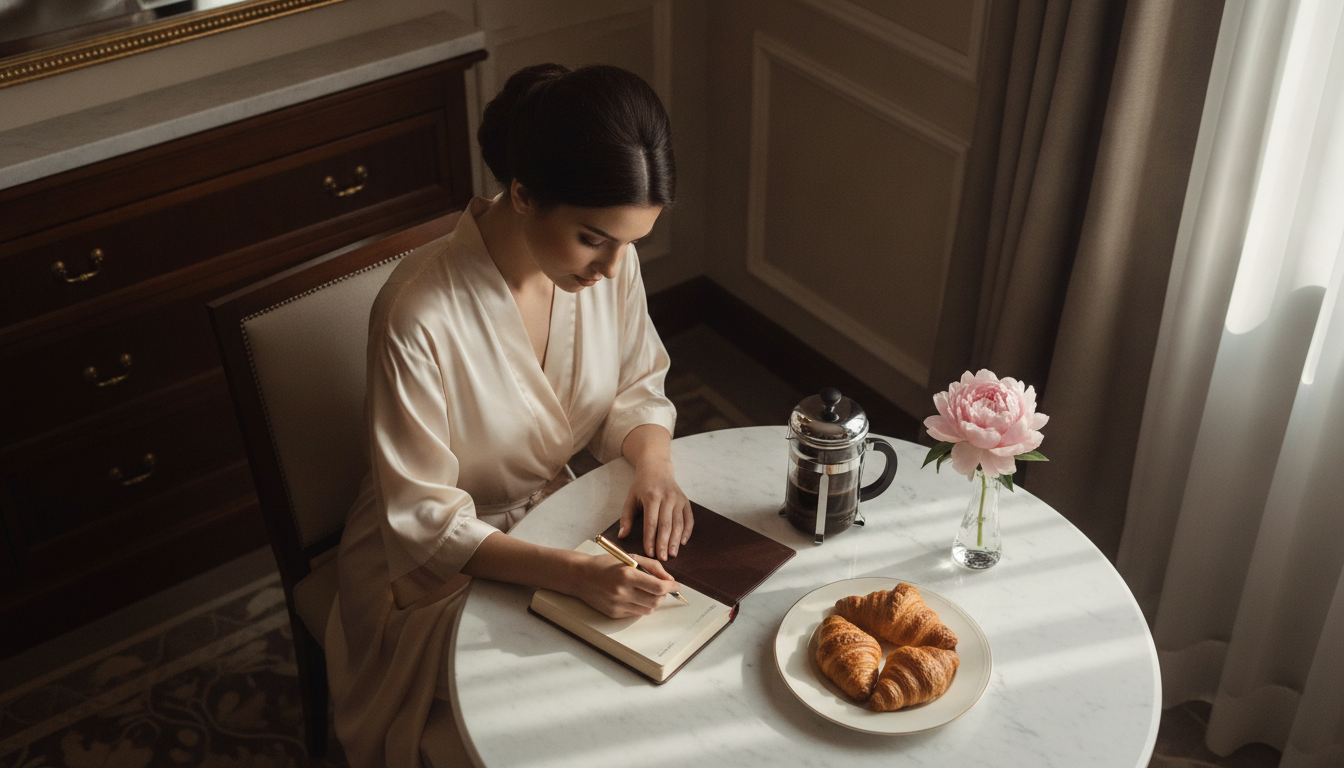
After months of experimenting, I've found out which simple mindfulness rituals work for me in the long run. They aren't the Instagram-worthy yoga sessions or the expensive wellness retreat, but the small, repeatable moments.
- The 5-senses exercise while waiting: whether on the subway or before a meeting, I consciously name 5 things I see, 4 I hear, 3 I feel, 2 I smell, and 1 I taste. This exercise pulls me out of the thought carousel and straight into the present.
- Mindful eating at one meal at least: at breakfast I put my phone away and focus on taste, texture, and temperature. A croissant from the Heberer bakery in Frankfurt becomes a 10-minute retreat.
- An evening reflection with three questions: What went well today? What am I grateful for? What could I have done differently? Writing these three questions in my journal takes five minutes at most, but it gives my day structure and meaning.
- A body scan before falling asleep: 10 minutes in which I mentally wander through my body, noticing tension and consciously releasing it. This self-care routine has improved my sleep quality enormously.
All told, these rituals cost me about 60 minutes a day. That sounds like a lot, but according to a 2024 survey by Germany's Federal Statistical Office, Germans spend an average of 3 hours and 15 minutes a day consuming media. So I've only redirected a fraction of that, and the return for my mental health is priceless.
How to Realistically Learn Meditation as a Working Woman
When I started meditating, I made every classic mistake. I bought expensive cushions, downloaded three different apps, and set myself the goal of meditating 30 minutes a day. After four days, I gave up in frustration. The problem wasn't my willpower but my unrealistic expectations.
The breakthrough came when I took a course at the Mindfulness Academy in Berlin. The instructor, Dr. Sarah Bennett, said something that changed everything: "Meditation isn't the goal, meditation is the path. And that path begins with one minute." So I started with exactly 60 seconds a day. After two weeks I increased to 3 minutes, after a month to 5, and after three months I'd found my steady 15 minutes.
To get started, I use the app "7Mind", which is even covered under some plans by the German health insurer Barmer. The guided meditations are in German, run between 7 and 20 minutes, and cover concrete topics like stress, sleep, or self-compassion. No esoteric promises, just practical guidance. (If you're in the US, apps like Headspace or Insight Timer offer a similar beginner-friendly approach.)
My Personal Self-Care Routine for Demanding Weeks
There are weeks when even my established rituals reach their limits. Several dinner dates, work projects, and maybe a trip with one of my arrangements from the lifestyle dating scene leave little room for extended self-care. For those phases, I've developed an emergency routine.
The minimum I never go below: a 10-minute morning ritual and a 5-minute evening ritual. Those 15 minutes are my non-negotiables. On top of that come three "mindfulness anchors" spread throughout the day: 5 conscious breaths before getting out of bed, a phone-free walk at lunch, and a gratitude note before going to sleep. These mini-rituals keep me grounded even when everything around me turns chaotic.
On especially demanding days, I deliberately treat myself to a "slow moment". That might be a visit to the Käfer delicatessen café in Munich, where I take 30 minutes just for a cappuccino and a good book. Or an aimless stroll through the Englischer Garten, paying attention only to the season, the sounds, the colors. These deliberate pauses aren't a waste of time but an investment in my performance.
The Connection Between Inner Balance and Outer Success

What I've learned over the past few months: daily mindfulness rituals don't contradict ambition and success, they're the foundation for them. The more present I am in conversations, the better I can build real connections. The clearer my mind, the better the decisions I make. The more balanced I am, the more attractive I come across.
This balance also shows in how I shape my arrangements in lifestyle dating. Instead of experiencing every date as a performance where I have to function, I bring real presence. I actually listen instead of already formulating the next charming reply. I enjoy dinner at the exclusive restaurant instead of mentally being at the next appointment already. That quality of attention makes the difference between a nice evening and a truly special experience.
According to a 2023 study by Ludwig Maximilian University of Munich, regular mindfulness practice improves not only stress resilience but also emotional intelligence, by an average of 23%. This ability to better perceive and regulate your own emotions and those of others is invaluable in lifestyle dating.
Frequently Asked Questions About Daily Mindfulness Rituals
How do I find time for mindfulness rituals with a packed schedule?
You don't need extra time, you need to use existing time differently. Start with 5 minutes in the morning before you check your phone. Use waiting time for conscious breathing exercises instead of social media. Replace one of your daily coffee breaks with a short mindful walk. It's not about doing more, but about experiencing what you already do more consciously.
Which simple mindfulness rituals can I start right away?
The 5-senses exercise works anytime, anywhere: name 5 things you see, 4 you hear, 3 you feel, 2 you smell, 1 you taste. It takes 2 minutes and brings you into the moment immediately. Or try 4-7-8 breathing: inhale for 4 seconds, hold for 7, exhale for 8, and repeat four times. Perfect before important conversations or in moments of acute stress.
How long does it take for mindfulness rituals to take effect?
I noticed first effects such as better concentration or milder stress reactions after about 2 weeks of daily practice. Lasting changes like better sleep, greater emotional stability, and clearer decision-making showed up after 8 to 12 weeks. A 2024 study from Charité Berlin shows that 8 weeks of regular meditation, at least 10 minutes a day, leads to measurable changes in brain structure, especially in areas responsible for stress regulation and attention.
What do I do if I can't switch off during meditation?
That's completely normal and part of the process. Meditation doesn't mean having no thoughts, it means noticing when thoughts arise and gently bringing your attention back. I use a simple trick for this: when a thought pops up, I silently say "thinking" and return to my breath. No judgment, no frustration, just a neutral observation. Over time the gaps between thoughts get longer, but the goal isn't a thought-free mind, it's conscious observation.
Do I need special equipment or apps for mindfulness?
No. Your breath, your attention, and 5 minutes of time are all you need. I use the 7Mind app for support and a simple notebook for my reflections, but those are tools, not prerequisites. An expensive meditation cushion won't make you more mindful than a regular corner of your couch. What counts is consistency, not equipment. Start with what you have, right where you are.
What I Do Differently Today Compared to a Year Ago
The biggest difference isn't the number of my mindfulness rituals but my attitude toward them. They used to be an item on my to-do list; now they're the foundation that makes the list work at all. I plan my meetings around my morning routine, not the other way around. I cancel appointments when I notice I need a break. I treat my mental health with the same priority as an important business lunch.
This attitude has also changed how I shape my arrangements in lifestyle dating. I'm more deliberate about who I spend my time with. I communicate more clearly what I need to keep my balance. And I've learned that real appreciation also means being appreciative toward myself.
My daily mindfulness rituals are not a perfect science. There are days when I only manage the minimum, and days when I spend an hour in silence. But the constant is that I always come back. To my breath, to my body, to this moment. And that's exactly where true inner balance lies, not in perfect execution, but in beginning again and again.